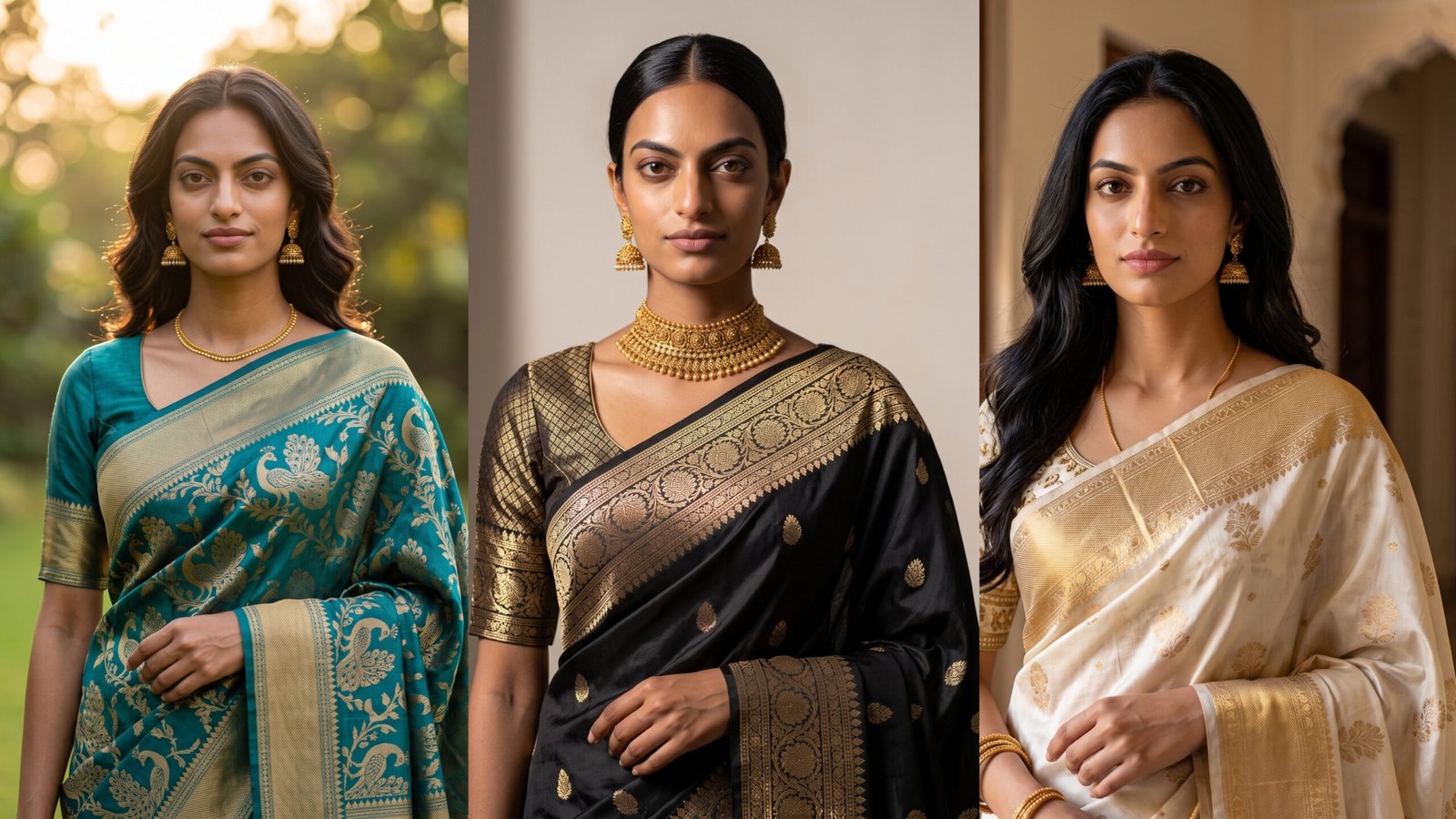
A Banarasi saree is one of the fastest ways to turn a plain selfie into a portrait that feels regal, and these 10 Gemini AI prompts are built specifically around that fabric’s gold zari work, heavy borders, and rich color palette. Each prompt below is copy-paste ready, and every one of them locks in face preservation so the final portrait still looks like you.
Banarasi silk has a texture and shine that most generic “saree prompt” templates don’t account for. The zari threadwork catches light in a specific way, the borders are usually wide and ornate, and the drape falls heavier than chiffon or georgette. Writing a prompt that ignores those details tends to produce a saree that looks vaguely Indian rather than authentically Banarasi. This list fixes that by naming the weave, the motif style, the jewelry, and the setting in every single prompt.
Here’s a quick look at what each prompt creates before you scroll through the full versions.
| Prompt Name | What It Creates | Use Case |
|---|---|---|
| Golden Zari Palace Portrait | Warm gold Banarasi saree in a palace courtyard | Festive or wedding-guest portraits |
| Crimson Bridal Banarasi Look | Deep red bridal saree with heavy jewelry | Bridal or engagement portraits |
| Royal Blue Temple Courtyard | Royal blue saree with a temple backdrop | Cultural or festival posts |
| Ivory and Gold Heritage Haveli | Ivory saree with gold border in a haveli | Elegant, understated traditional look |
| Emerald Green Silk Close-Up | Emerald saree, close-up beauty shot | Instagram profile or beauty-focused post |
| Mustard Yellow Courtyard Portrait | Mustard saree in natural daylight | Everyday festive occasions like Haldi |
| Maroon Velvet-Bordered Evening Look | Maroon saree with a dramatic evening mood | Evening event or reception portraits |
| Peacock Motif Garden Portrait | Saree with peacock motifs in a garden setting | Nature-themed traditional portrait |
| Black and Gold Contemporary Drape | Black saree with gold zari, modern styling | Fusion or editorial-style portrait |
| Pastel Pink Soft Glam Portrait | Soft pink saree with minimal jewelry | Daytime or subtle occasion portraits |
Why Banarasi Sarees Need More Specific Prompts
Gemini’s Nano Banana model can generate a convincing saree from a short prompt, but Banarasi silk has identifying features that need to be named directly or the AI defaults to a generic silk drape. Three details make the biggest difference in the output:
- Zari work: Real Banarasi sarees use metallic gold or silver thread woven into the fabric. Mentioning “zari” or “zari weave” by name produces a noticeably different texture than just saying “gold saree.”
- Border width and motifs: Banarasi borders are typically wide, with kalga (paisley-like) and bel (floral vine) patterns. Naming these motifs helps the AI render a border that actually matches the style instead of a plain stripe.
- Fabric weight: Banarasi silk drapes heavier and stiffer than chiffon or georgette. Prompts that specify “structured pleats” or “heavy silk fall” produce a more accurate drape than prompts that leave fabric weight unspecified.
Combining these details with a face-preservation instruction and a specific setting is what separates a prompt that looks styled from one that looks generated.
Prompt #1: Golden Zari Palace Portrait
Concept: A warm, golden-toned Banarasi saree photographed against a palace backdrop, built for festive or wedding-guest portraits where the gold tones should dominate the frame.
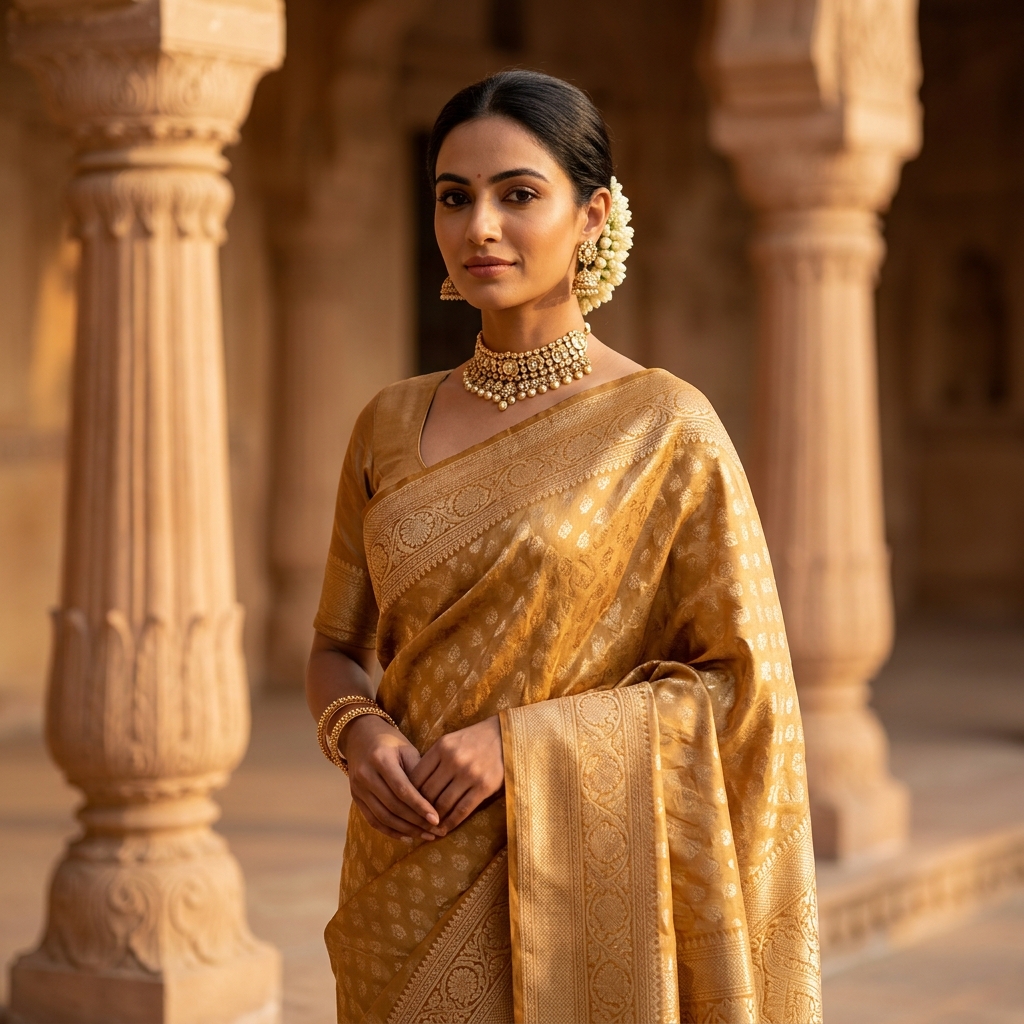
Prompt: “Using the uploaded photo as the face and identity reference, keep the person’s facial features, skin tone, and expression 100% unchanged. Dress her in a rich golden Banarasi silk saree with intricate zari weaving, kalga and bel motifs along a wide contrast border, paired with a matching golden-toned blouse. Add a Kundan choker necklace, matching jhumka earrings, and a few gold bangles. Hair styled in a low bun with a small gajra of flowers. Setting: an ornate palace courtyard with carved sandstone pillars softly blurred in the background. Lighting is warm and golden-hour, with soft shadows highlighting the saree’s texture. Shot on an 85mm lens, shallow depth of field, ultra-realistic skin texture, ISO 200, ultra HD portrait quality.”
Best for: Wedding-guest looks, festive Instagram posts, or anyone wanting a rich, celebratory portrait.
Pro Tip: If the gold tone comes out too orange, add “cooler gold tone, less amber cast” to the prompt and regenerate.
Prompt #2: Crimson Bridal Banarasi Look
Concept: A deep red bridal Banarasi saree paired with heavy traditional jewelry, designed for bridal or engagement-style portraits.
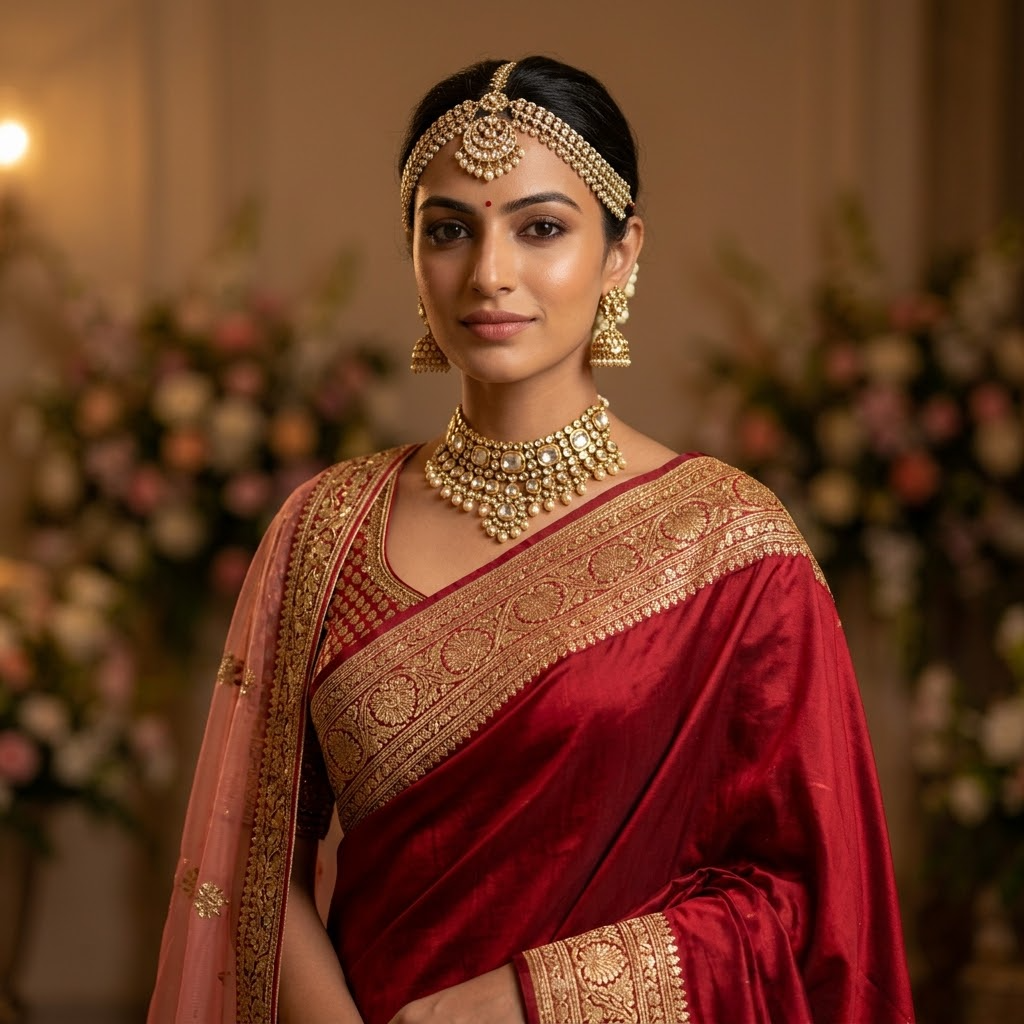
Prompt: “Keep the face, skin tone, and facial structure from the uploaded reference image exactly the same, do not alter any features. Create a bridal portrait of the same person wearing a deep crimson Banarasi silk saree with intricate golden zari embroidery along a heavy border, paired with a matching red and gold blouse. Add heavy Kundan and polki bridal jewelry, including a maang tikka, layered necklace, and matching earrings. A light red dupatta drapes over one shoulder. Setting: a softly lit indoor room with warm ambient light and a blurred floral backdrop. Camera style: cinematic close-up beauty shot, soft glow on the skin, premium fabric texture visible in the folds, 4K realism.”
Best for: Bridal portraits, engagement announcements, or festive wedding-season content.
Pro Tip: For a more natural bridal glow, add “soft diffused lighting, minimal harsh shadows” rather than direct studio lighting.
Prompt #3: Royal Blue Temple Courtyard
Concept: A royal blue Banarasi saree photographed in a temple courtyard setting, suited to cultural or festival-themed posts.
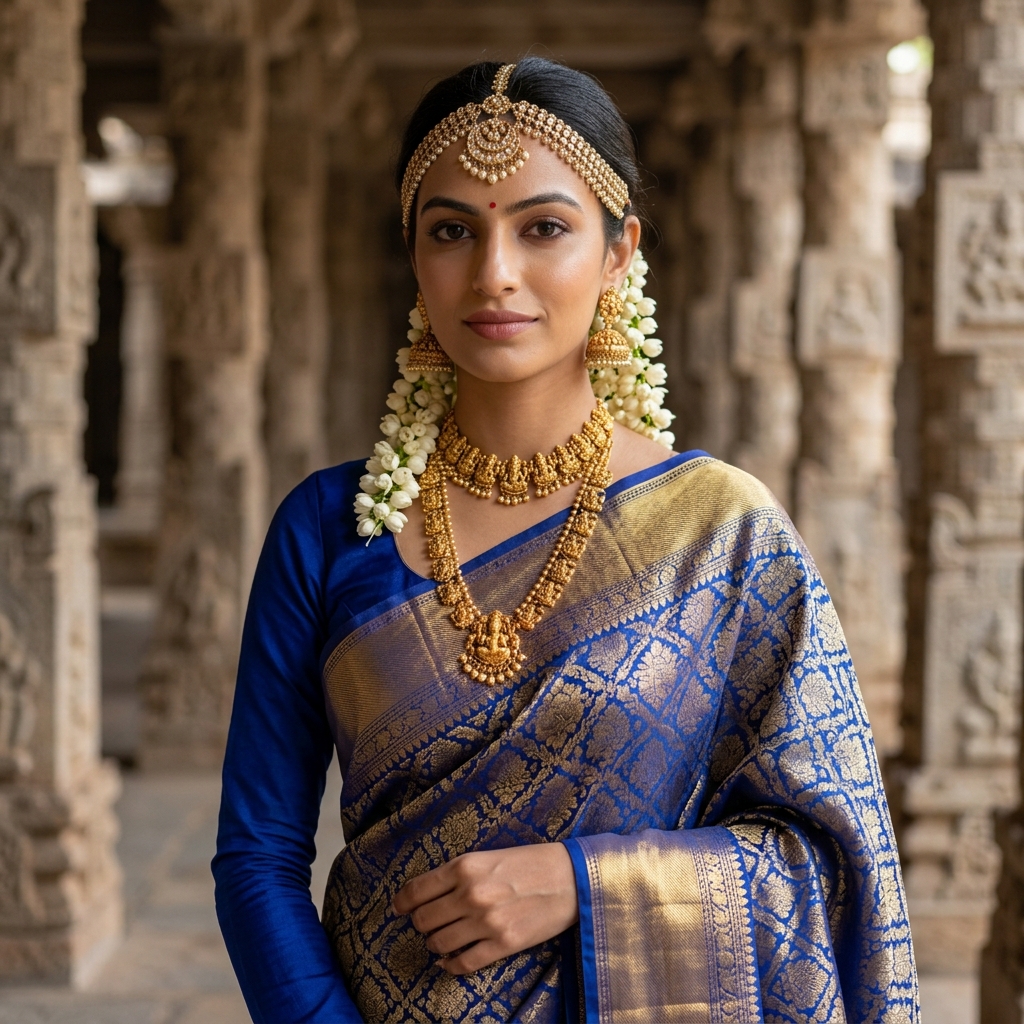
Prompt: “Preserve the exact facial features, skin tone, and expression from the uploaded photo, only change the outfit and background. Dress the person in a royal blue Banarasi silk saree with heavy gold zari weave and a wide contrast gold border, paired with a full-sleeve fitted blouse in a matching blue tone. Add gold temple jewelry, including a layered necklace and jhumka earrings, with a small bindi and jasmine flowers pinned into the hair. Setting: a stone temple courtyard with carved pillars and soft natural daylight. Composition: standing pose with one hand gently holding the pallu, symmetrical framing, sharp focus on the face, shot on a 50mm lens with natural color grading.”
Best for: Festival posts, temple visits, or culturally themed profile portraits.
Pro Tip: Mention “natural daylight, no artificial studio light” if you want the temple stone tones to look accurate rather than overly warm.
Prompt #4: Ivory and Gold Heritage Haveli
Concept: An ivory Banarasi saree with a gold border, photographed inside a heritage haveli for an understated but elegant traditional look.
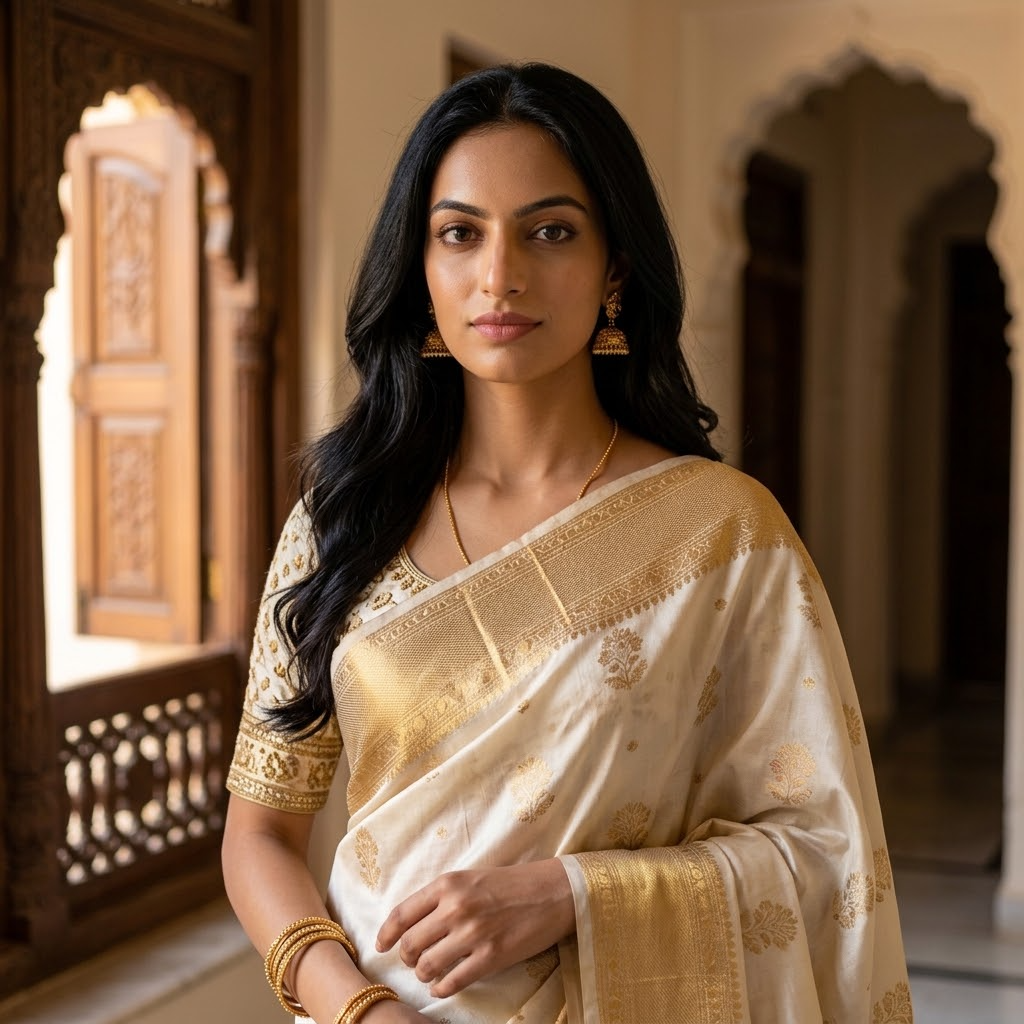
Prompt: “Using the uploaded image as the identity reference, keep the face, jawline, and skin tone exactly as they appear, do not regenerate the facial features. Dress her in an ivory Banarasi silk saree with a rich gold zari border and delicate floral motifs, paired with a cream and gold embroidered blouse. Add simple gold jhumkas, a thin gold chain, and a few gold bangles for a refined look. Hair left open with soft waves. Setting: inside a heritage haveli with a carved wooden window and warm indoor light falling across the face. Camera style: editorial portrait photography, soft focus background, realistic fabric folds, 4K sharp detail on the face.”
Best for: Elegant, understated traditional portraits that avoid heavy bridal styling.
Pro Tip: Ivory fabric can appear washed out under strong light — add “balanced exposure, avoid overexposed highlights on the fabric” for cleaner results.
Prompt #5: Emerald Green Silk Close-Up
Concept: A close-up beauty-style portrait in an emerald green Banarasi saree, built for profile photos where the face is the main focus.
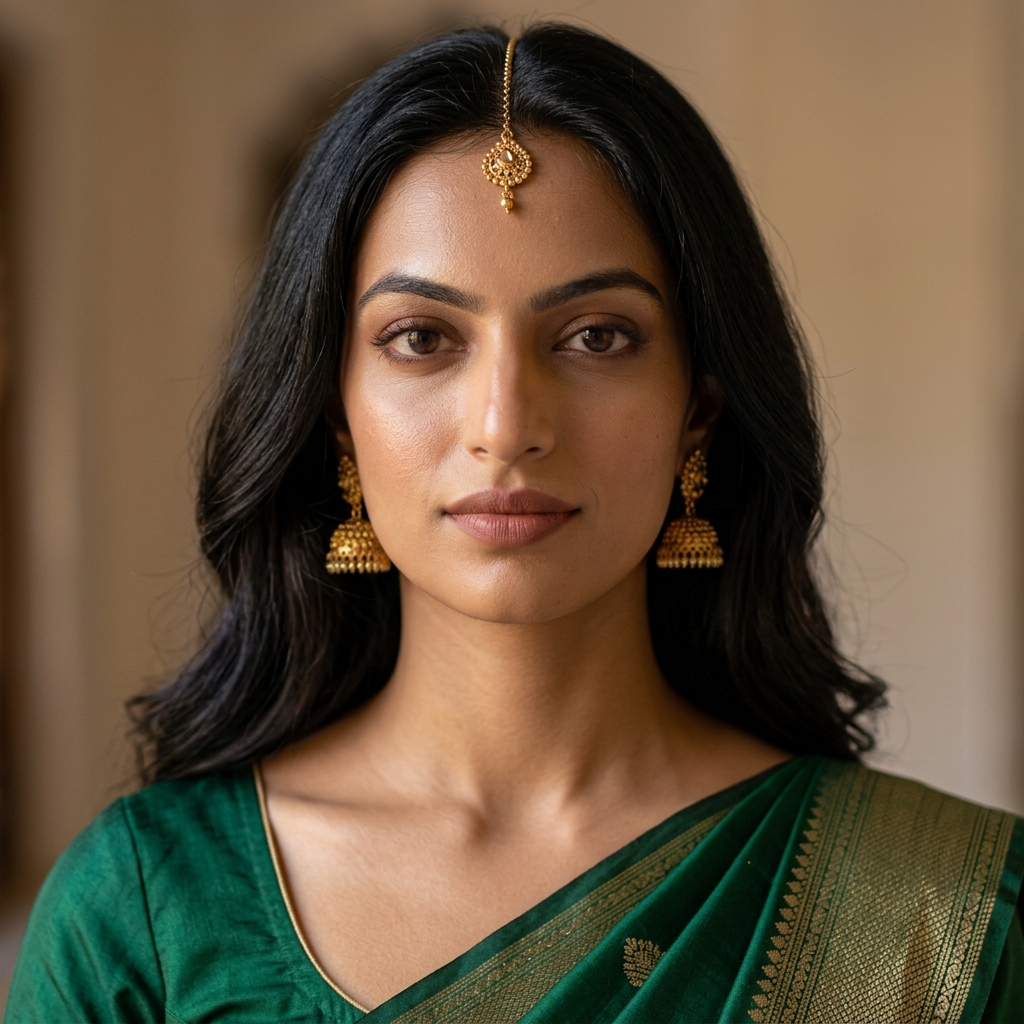
Prompt: “Keep the person’s facial identity, skin texture, and proportions identical to the uploaded reference photo. Create a close-up beauty portrait of the same person wearing an emerald green Banarasi silk saree with fine gold zari detailing visible near the shoulder and pallu. Add gold jhumka earrings, a delicate maang tikka, and natural glam makeup with a soft brown eyeshadow tone. Background softly blurred in a warm neutral tone. Camera style: close-up beauty shot, shallow depth of field, f/1.8 aperture, sharp focus on the eyes and skin texture, cinematic soft lighting, ultra-realistic 4K portrait.”
Best for: Profile pictures, beauty-focused posts, or portraits where facial detail matters more than the full outfit.
Pro Tip: Since this is a close-up, most of the saree won’t be visible — keep the fabric mention brief and put more detail into lighting and skin texture instructions.
Prompt #6: Mustard Yellow Courtyard Portrait
Concept: A mustard-gold Banarasi saree shot in natural daylight, well suited to everyday festive occasions like Haldi ceremonies.
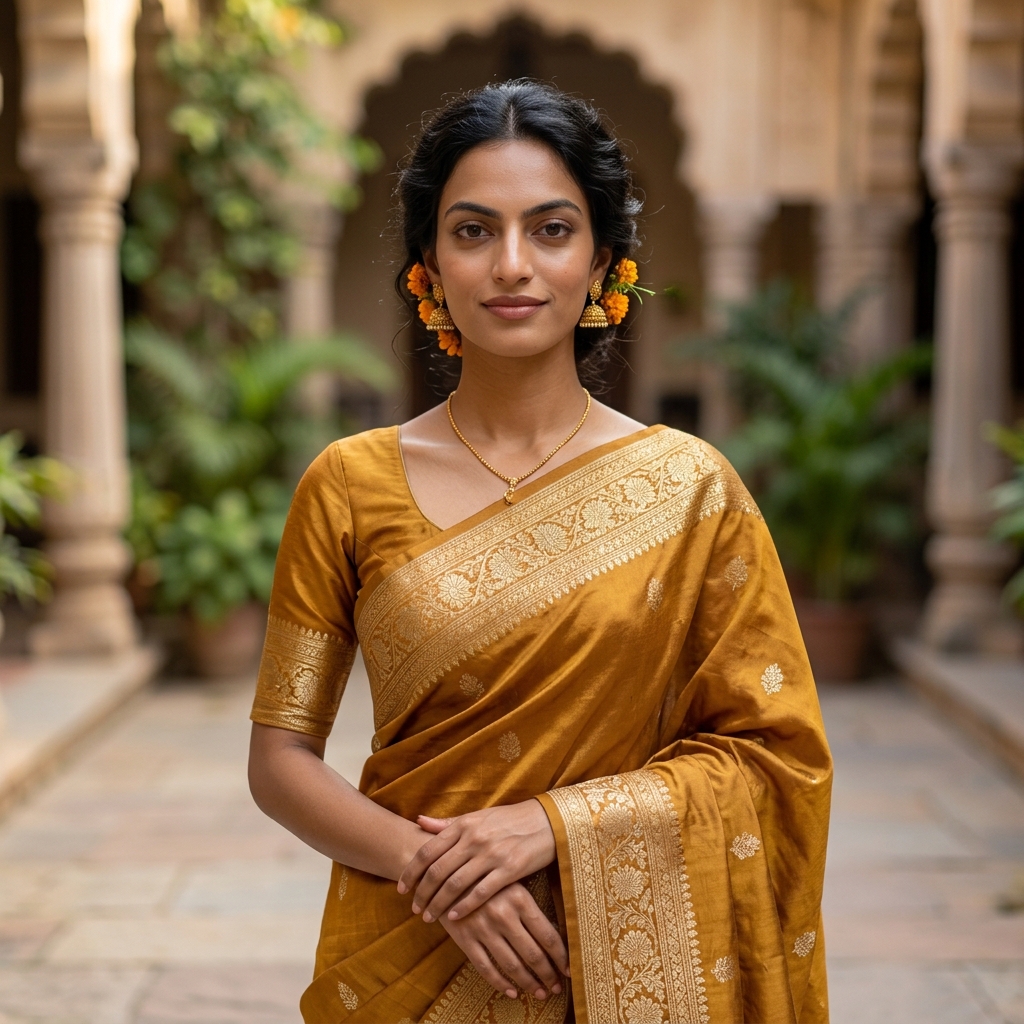
Prompt: “Do not change the facial features, skin tone, or expression from the uploaded photo. Dress the person in a mustard gold Banarasi silk saree with intricate zari weaving and delicate floral motifs along the border, paired with a matching mustard blouse. Add simple gold jewelry, including small jhumkas and a thin necklace, with fresh marigold flowers tucked into the hair. Setting: an open courtyard with natural daylight, a stone floor, and soft greenery blurred in the background. Composition: standing pose, natural smile, realistic shadows, shot on a DSLR with natural color tones and sharp facial detail.”
Best for: Haldi ceremonies, daytime festive events, or bright, cheerful traditional portraits.
Pro Tip: Mustard tones can shift toward orange under warm lighting — specify “true mustard tone, not orange-shifted” if the color drifts during generation.
Prompt #7: Maroon Velvet-Bordered Evening Look
Concept: A maroon Banarasi saree with a heavier, more dramatic mood, built for evening event or reception-style portraits.
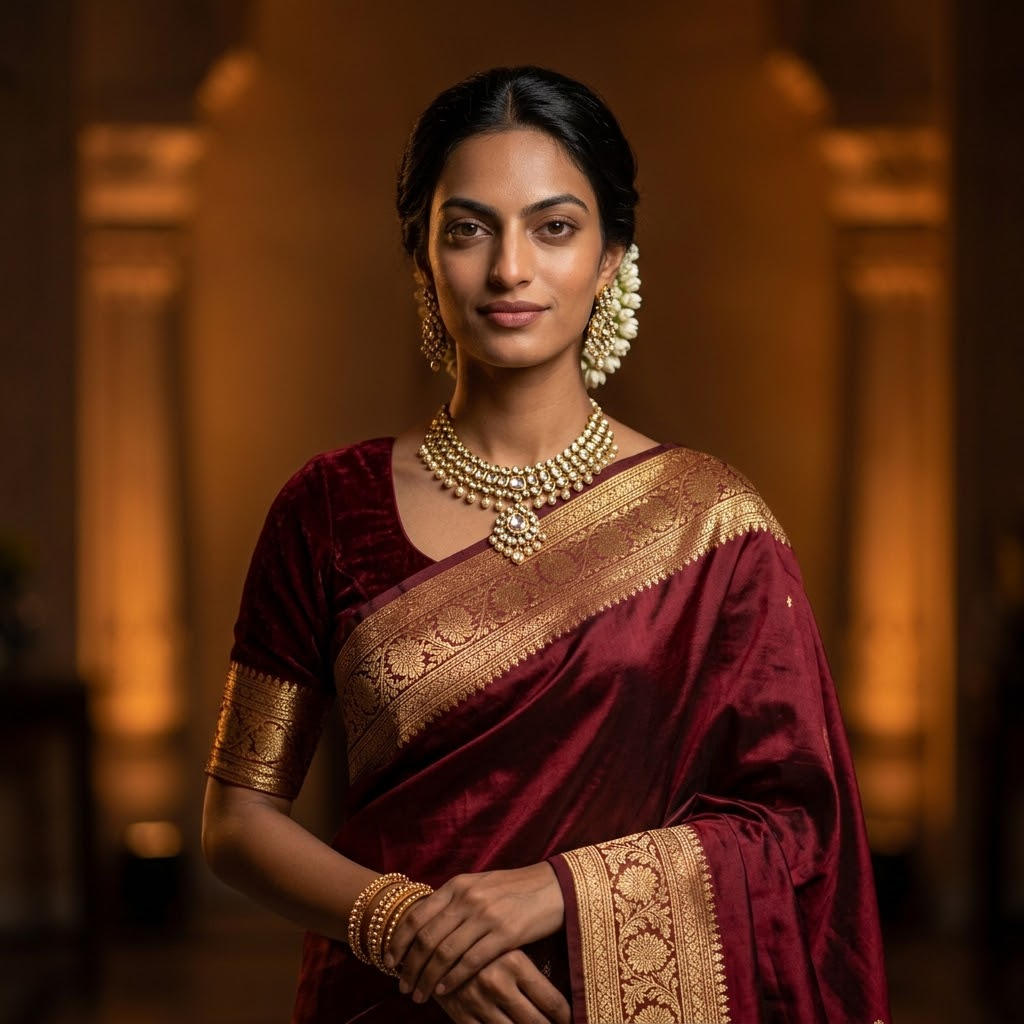
Prompt: “Preserve the exact face, skin tone, and expression from the uploaded reference image, only the outfit and lighting should change. Create a portrait of the same person wearing a maroon Banarasi silk saree with a heavy gold zari border and rich velvet-textured blouse in a matching deep tone. Add a statement Kundan necklace, matching earrings, and a few gold bangles. Hair styled in a low bun with a single gajra strand. Setting: a dimly lit indoor space with warm amber uplighting and soft shadows. Camera style: dramatic cinematic lighting, shallow depth of field, 85mm lens, rich color grading, ultra-realistic fabric texture.”
Best for: Evening receptions, festive dinners, or portraits with a moodier, more dramatic tone.
Pro Tip: Dim lighting prompts can sometimes darken the face too much — add “face remains clearly lit and visible despite ambient lighting” to keep facial detail sharp.
Prompt #8: Peacock Motif Garden Portrait
Concept: A Banarasi saree featuring peacock motifs, photographed in a garden setting for a softer, nature-themed traditional look.
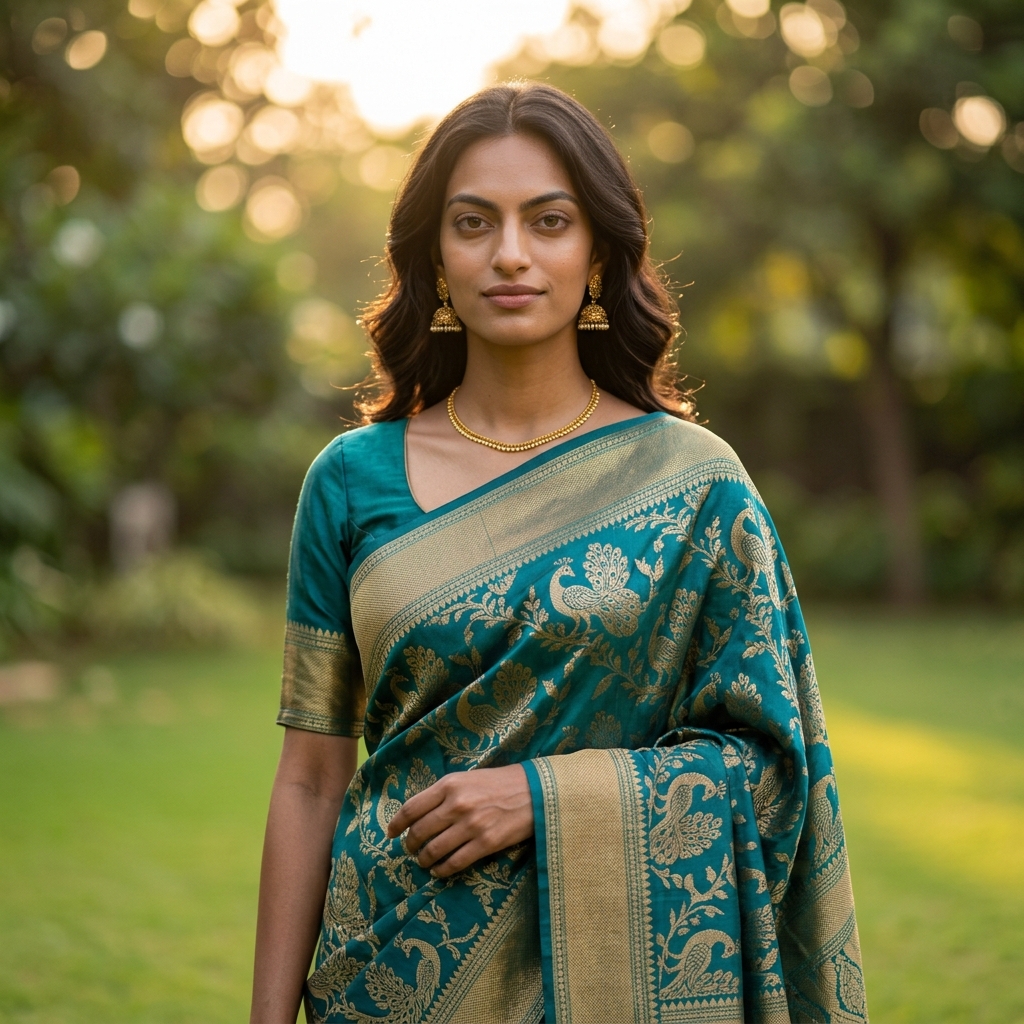
Prompt: “Keep the facial features, skin tone, and expression from the uploaded photo completely unchanged. Dress the person in a teal and gold Banarasi silk saree with intricate peacock motifs woven into the pallu and a wide gold zari border, paired with a matching teal blouse. Add gold jhumka earrings and a thin gold necklace, with hair left open in soft waves. Setting: a lush green garden at golden hour, soft natural light filtering through trees. Composition: relaxed standing pose, one hand lightly holding the pallu, warm golden-hour tones, cinematic bokeh, realistic skin and fabric texture.”
Best for: Outdoor traditional portraits with a softer, romantic feel rather than a formal indoor look.
Pro Tip: Peacock motifs are intricate — mentioning “clearly visible peacock motif detail on the pallu” helps prevent the AI from simplifying the pattern.
Prompt #9: Black and Gold Contemporary Drape
Concept: A black Banarasi saree with gold zari work, styled with a slightly more modern, editorial feel for fusion-style content.
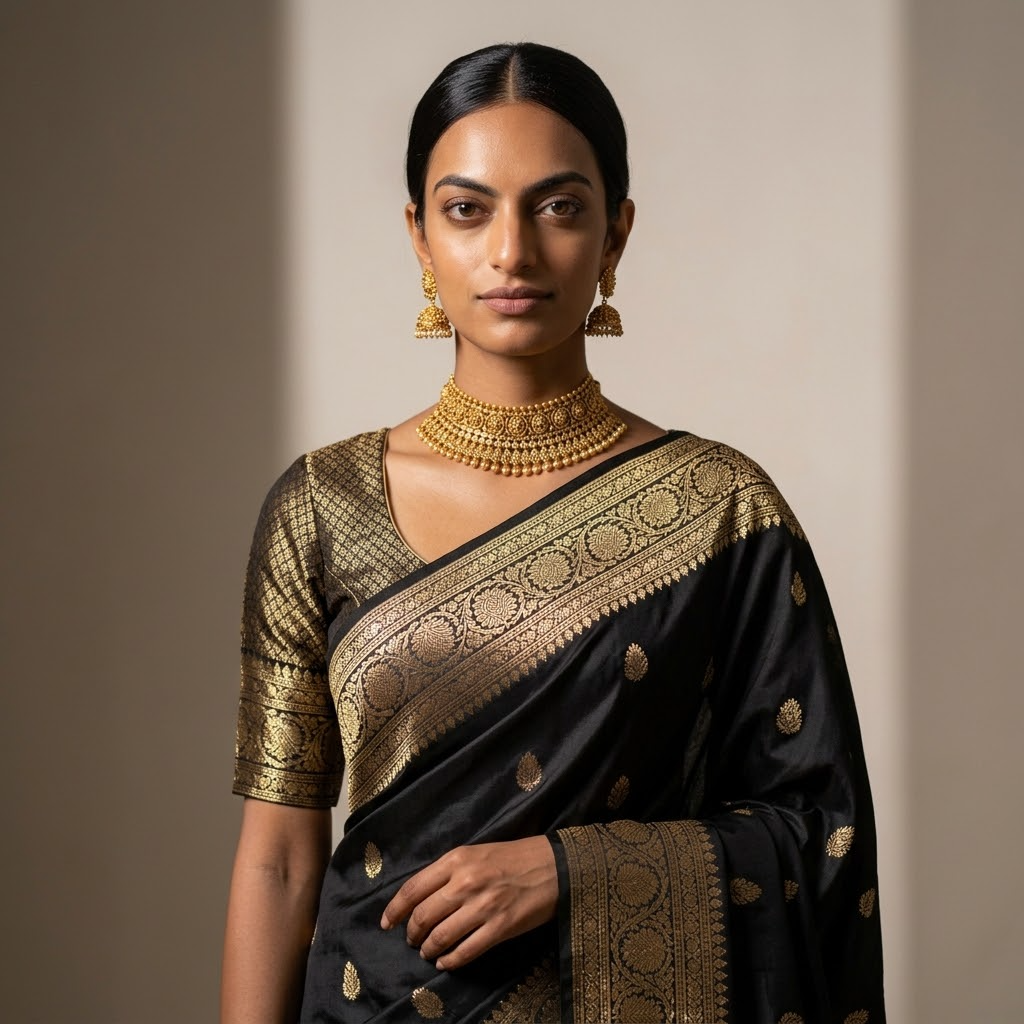
Prompt: “Using the uploaded image as the identity reference, keep the face, proportions, and skin tone exactly the same, do not alter any facial features. Dress her in a black Banarasi silk saree with heavy gold zari motifs along the border and pallu, paired with a fitted black and gold blouse. Add a statement gold choker, matching earrings, and a sleek low bun with no additional flowers. Setting: a minimal studio background with soft directional lighting. Camera style: editorial fashion photography, sharp focus on the face, controlled studio lighting, high-contrast color grading, ultra HD detail on the saree’s zari work.”
Best for: Fusion or editorial-style content, portfolio shots, or a more contemporary take on traditional wear.
Pro Tip: High-contrast lighting can sometimes flatten skin texture — add “retain natural skin texture, avoid over-smoothing” if the result looks too airbrushed.
Prompt #10: Pastel Pink Soft Glam Portrait
Concept: A soft pastel pink Banarasi saree with minimal jewelry, designed for daytime portraits or subtle, low-key occasions.
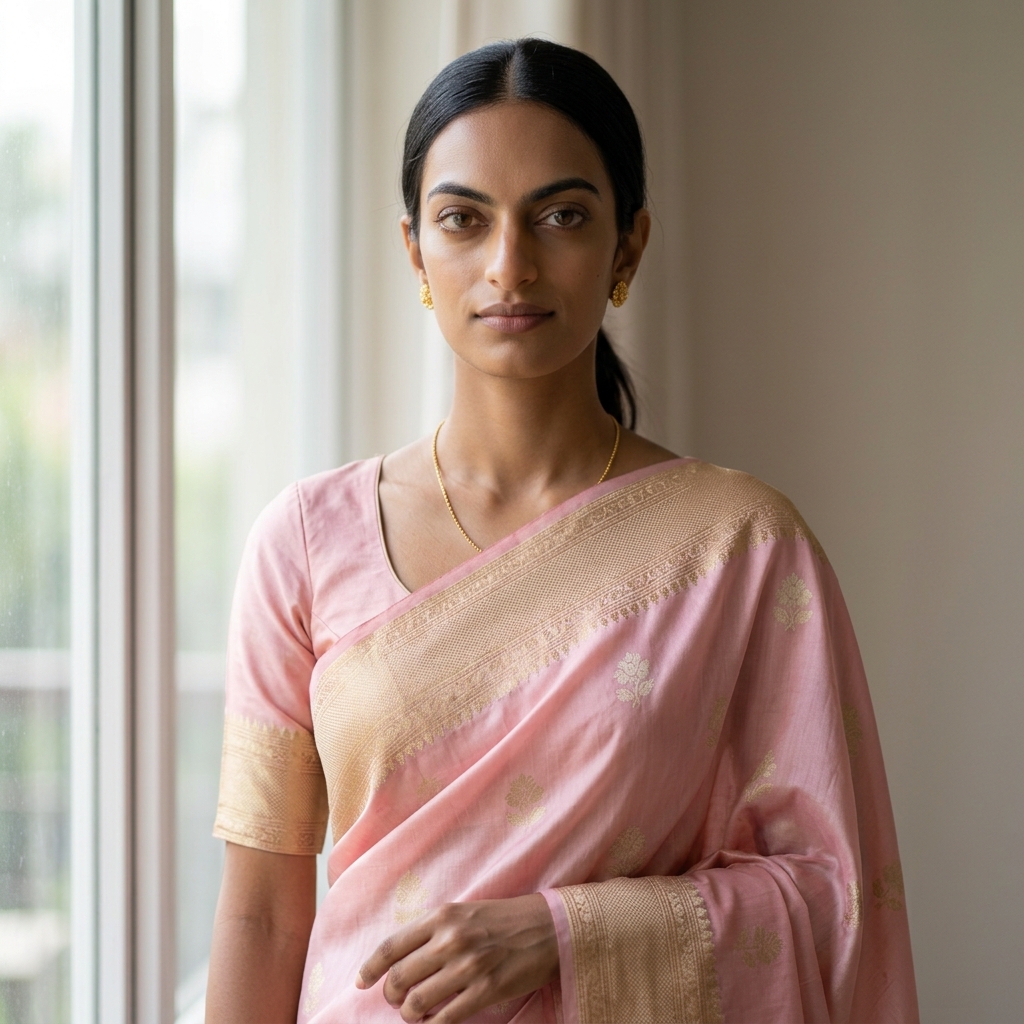
Prompt: “Do not change the facial structure, skin tone, or expression from the uploaded reference photo. Dress the person in a soft pastel pink Banarasi silk saree with a delicate gold zari border and light floral motifs, paired with a matching pastel blouse. Add minimal gold jewelry, including small stud earrings and a thin chain, with hair tied in a simple low ponytail. Setting: a softly lit indoor space near a window with natural daylight. Camera style: soft natural lighting, gentle shadows, realistic skin tone, minimal color grading, sharp but natural-looking portrait detail.”
Best for: Daytime portraits, subtle festive occasions, or anyone who prefers a lighter, less dramatic traditional look.
Pro Tip: Pastel fabrics can look flat under flash-style lighting — specify “soft window light, no flash” to keep the color true to the pastel tone.
Tips for Better Banarasi Saree Results in Gemini
A few adjustments consistently improve the accuracy of Banarasi-specific portraits:
- Use a clear, well-lit reference photo with the face fully visible and not obscured by hair or shadows.
- Always name the fabric as “Banarasi silk” rather than just “silk saree” — generic terms produce a flatter, less accurate texture.
- Mention specific motifs (zari, kalga, bel, peacock) rather than leaving the border pattern unspecified.
- Generate each prompt two to three times, since later attempts often refine the drape and jewelry detail.
- If the face shifts or changes slightly, add “preserve facial identity 100%, do not alter facial features or proportions” at the very start of the prompt.
For grooms working on a coordinating traditional look, the 8 Regal Sherwani Look Gemini AI Prompts for Grooms covers a matching set of prompt styles built the same way.
Frequently Asked Questions
Will the saree look exactly like a real Banarasi silk texture?
It depends on how specific the prompt is. Naming the zari weave, border motifs, and fabric weight directly — as each prompt above does — produces a noticeably closer match to real Banarasi silk than a generic “gold saree” prompt.
Can I change the saree color in these prompts?
Yes. Every prompt can be edited by swapping the color name (for example, changing “royal blue” to “wine red”) while keeping the rest of the structure, including the zari and motif details, unchanged.
Why does my face sometimes change slightly after generating?
This can happen when the prompt doesn’t clearly prioritize identity preservation. Placing a face-preservation instruction at the very beginning of the prompt, rather than the end, tends to produce more consistent results.
Do I need a full-length photo for these prompts to work?
A half-body or full-length photo works best since it gives Gemini more of the drape to reference. A close-up selfie can still work, but the saree details will rely more on the prompt description than the photo itself.
Can these prompts be used for festive occasions other than weddings?
Yes. Prompts like the Mustard Yellow Courtyard Portrait or Ivory and Gold Heritage Haveli work well for Diwali, Puja, or general festive portraits, not only weddings.
Pick one of these prompts, swap in the color or setting you want, and generate a portrait that actually reflects Banarasi silk’s texture and detail instead of a generic saree look. If bridal styling is more your focus, the 10 Ultra-Realistic Gemini AI Prompts for Bridal Lehenga Portraits is worth trying next, and for outdoor or destination-style shoots, the 8 Beach Pre-Wedding Gemini AI Prompts for Indian Couples offers a different setting to experiment with.
2 thoughts on “10 Banarasi Saree Gemini AI Prompts for Traditional Portraits”